Guide
Holiday calendars for derivatives: getting long-dated cash flows right
A 30-year swap pays until 2056, and every payment date is adjusted for holidays. Here is how dates are set, what one wrong day costs, and why calendars change after the trade.

Julien Desaunay
Last reviewed 9 November 2026 · 3 min read
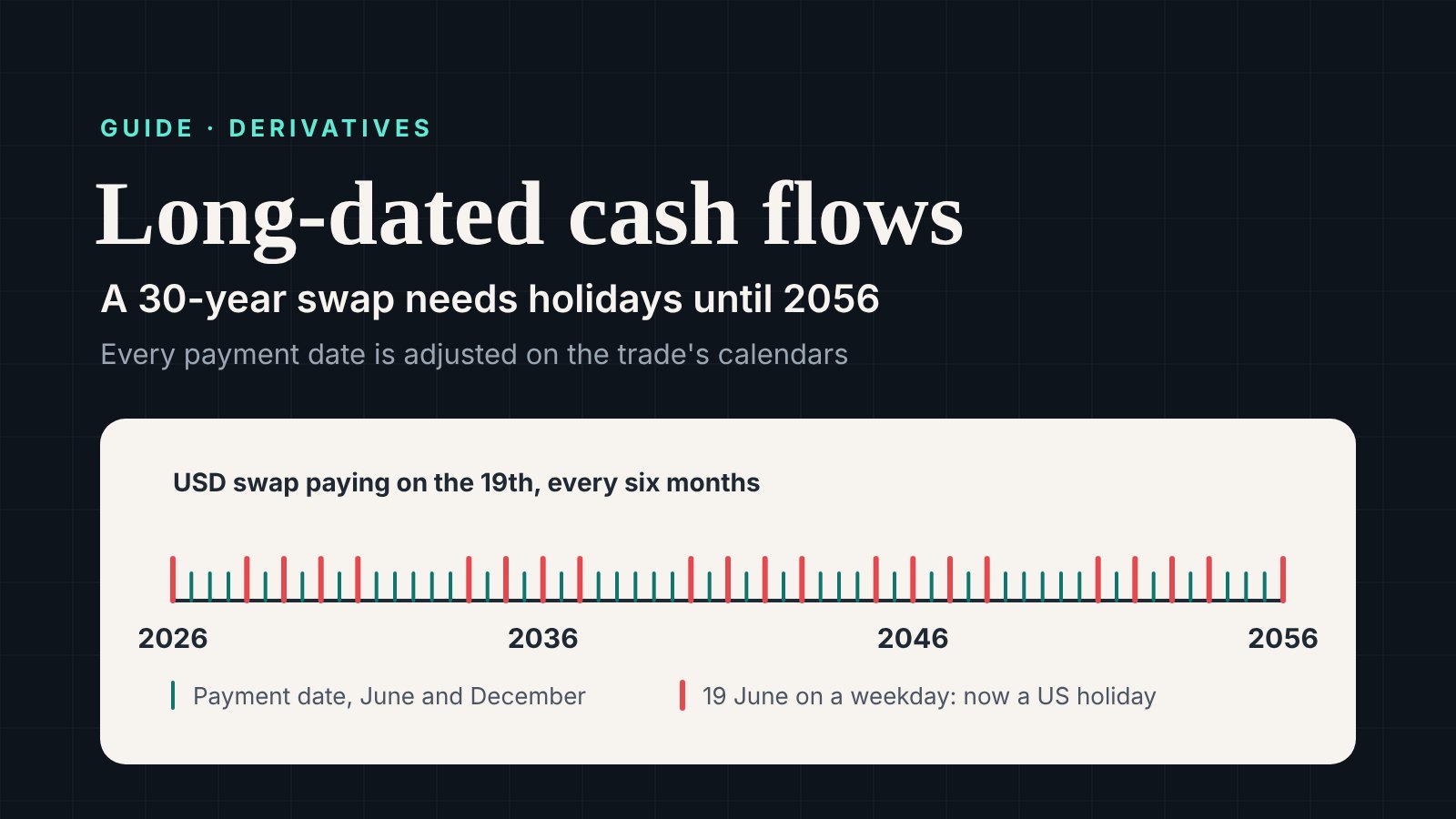
A 30-year swap traded today pays until 2056. Each payment date is moved off weekends and holidays. If the holiday calendar is wrong, the date is wrong. So is the cash flow, and so is the price.
This guide explains how payment dates are set and what one wrong day costs. It also shows why calendars need care for decades.
How a payment date is set#
A swap, bond or loan has a schedule. It starts from simple dates, such as the 15th of every sixth month. These are the unadjusted dates.
Each unadjusted date is then moved if it falls on a closed day. Two things decide where it goes:
- The calendars. The trade confirmation names the business centres, such as New York and London. A date must be open in all of them.
- The business day convention. The most common one is modified following. The date moves to the next open day, unless that is in the next month. Then it moves back instead.
These conventions are defined in the ISDA Definitions, which most swap confirmations use.
What one wrong day costs#
Take a swap with a notional of 100 million dollars and a rate of 4%. Interest is counted on actual days over 360.
- One day of interest is worth about 11,111 dollars.
- Move a payment date by a day, and one period gets a day longer. The next one gets a day shorter.
- The payment is also discounted from a different date.
The numbers are small per trade. But a book has thousands of trades. And a date that differs from your counterparty's or the clearing house's becomes a break to fix by hand.
Calendars change after the trade#
A calendar is not fixed when the trade is booked. New holidays appear.
- Juneteenth. It became a US federal holiday in June 2021. The Federal Reserve has closed for it since 2022. Between 2026 and 2056, 19 June falls on a weekday 22 times. A payment date on any of those days now moves.
- UK one-off bank holidays. The UK added the Platinum Jubilee on 3 June 2022 and the Coronation on 8 May 2023. The State Funeral of Queen Elizabeth II, on 19 September 2022, came with less than two weeks of notice.
- Fri 19 Jun: Juneteenth National Independence Day
Red: closed. Amber: half day or early close. Grey: weekend. Full USNYC.BANK calendar
Calendars must reach the maturity#
A 30-year trade needs holidays until 2056. A 50-year trade needs them until 2076. Many sources stop a few years ahead.
Our calendars are generated from rules through 2077. Holidays that depend on the moon, such as Eid or Chinese New Year, are marked as estimated far ahead. One-off holidays cannot be known in advance. That is why calendars must be refreshed, not set once.
Payment calendar or fixing calendar?#
A floating-rate leg has two kinds of dates. Payment dates follow the business centres of the trade. Rate fixings follow the calendar of the rate itself.
| Rate | Published on |
|---|---|
| SOFR | US government securities business days |
| SONIA | London business days |
| €STR | TARGET2 business days |
The two calendars are not always the same. Use the right one for each date.
A practical checklist#
- Store the unadjusted dates. Keep the dates from the contract before any holiday moves.
- Adjust them with today's calendars. Re-run the adjustment every day, so new holidays are picked up.
- Use joint calendars. A New York and London trade needs a day open in both.
- Separate payment and fixing calendars. They answer different questions.
- Watch estimated dates. Lunar holidays far ahead can still move when they are confirmed.
Try it#
The schedule endpoint builds an adjusted schedule for up to 60 years. This call builds the payment dates of a 30-year swap on New York and London days.
curl "https://api.tradingcalendars.com/v1/schedule?calendars=USNYC.BANK,GBLON.BANK&start=2026-11-30&end=2056-11-30&frequency=6M&convention=modified_following&end_of_month=true&payment_lag=2" \
  -H "Authorization: Bearer YOUR_API_KEY"
You can also load our calendars into your own library. This example builds a joint New York and London calendar for QuantLib, through 2077.
import QuantLib as ql
from tradingcalendars import TradingCalendars

tc = TradingCalendars()  # free API key

cal = ql.BespokeCalendar("NY+LDN")
cal.addWeekend(ql.Saturday)
cal.addWeekend(ql.Sunday)
for code in ("USNYC.BANK", "GBLON.BANK"):
    for d in tc.closure_dates(code, start="2026-01-01", end="2077-12-31"):
        cal.addHoliday(ql.Date(d.day, d.month, d.year))

cal.adjust(ql.Date(19, 6, 2026), ql.ModifiedFollowing)   # Juneteenth: 22 June 2026
More on schedules, conventions and fixing dates is in derivatives pricing and risk.
Sources#
- Federal Reserve: Holidays observed by the Federal Reserve System
- UK government: Bank holidays
- Federal Reserve Bank of New York: SOFR
- Bank of England: SONIA
- European Central Bank: €STR
About the author: Julien Desaunay, Founder, TradingCalendars.com
Julien works in fintech on derivatives pricing and risk technology, where every cash flow depends on the right holiday calendar. He founded TradingCalendars.com to make those calendars reliable and easy to use.
Calendars in this guide
Get new guides by email
Plus next week's market holidays every Friday. Unsubscribe in one click.
More guides
- How to build the date schedule of an equity-linked note
An equity-linked note uses three calendars: the stock exchange for fixings, the note currency for payments, and the clearing system. Here is how each date is set, with a worked example.
- Which holiday calendar do you need? Bank, payment, FX, trading or settlement
A country has more than one holiday calendar. On Columbus Day the NYSE trades but US banks are closed. Here are the six kinds of calendar, where they differ, and which one to use.
- How to calculate business days: holidays, joint calendars and odd weekends
Skipping weekends is not enough. Here is how to add and count business days correctly, with holidays, two cities at once, Gulf weekends and China's working Sundays.