Guide
How to build the date schedule of an equity-linked note
An equity-linked note uses three calendars: the stock exchange for fixings, the note currency for payments, and the clearing system. Here is how each date is set, with a worked example.

Julien Desaunay
Last reviewed 11 November 2026 · 5 min read
An equity-linked note pays a return tied to a stock or an index. Its term sheet lists a few key dates. Each one follows its own calendar. Mix them up, and the option is fixed on a day the market is closed. Or the money is due on a bank holiday.
This guide shows how each date is set. Then it builds the full schedule of a three-month note, with real holidays.
The dates in a term sheet#
| Date | What happens | Calendar |
|---|---|---|
| Trade date | The note is priced. The start level of the stock is fixed. | Stock exchange |
| Issue date | The investor pays and gets the note. | Note currency and clearing system |
| Observation dates | The stock is checked for a coupon or an early call. | Stock exchange |
| Final valuation date | The final level of the stock is fixed. | Stock exchange |
| Maturity date | The note is paid back. | Note currency and clearing system |
Three calendars, three jobs#
The stock exchange. A fixing needs a market price. So it must fall on a day the exchange is open. The ISDA equity definitions call this a scheduled trading day. A basket of stocks on several exchanges may need a day open on all of them. Some term sheets fix each stock on its own day instead.
The note currency. A payment needs banks open where the currency is settled. That is New York for dollars, TARGET2 for euros and London for sterling. Term sheets call these payment business days.
The clearing system. Most notes settle through Euroclear or Clearstream. Cash and notes only move on days the clearing system is open.
A note paid in a different currency from the stock adds a fourth calendar. The exchange rate is fixed on the calendar of its own fixing.
Add months, not days#
A tenor of three months means three calendar months. A note issued on 15 March has a scheduled final date of 15 June. Adding 90 days gives 13 June instead.
The day count, such as actual/360, sets no date at all. It only measures how much a coupon pays for a period.
Watch the month ends. Many term sheets add an end-of-month rule. Take a note issued on 30 November, the last day of the month. It then ends on the last day of February.
Then move each date to an open day#
A scheduled date can fall on a holiday. Each date then moves on the calendar of its own job.
- A fixing moves to the next scheduled trading day of the exchange.
- A payment is often set a number of payment business days after a fixing. Five is common. Other term sheets use a business day convention, such as modified following.
So maturity follows the final valuation. If the fixing moves, the payment moves too.
A worked example#
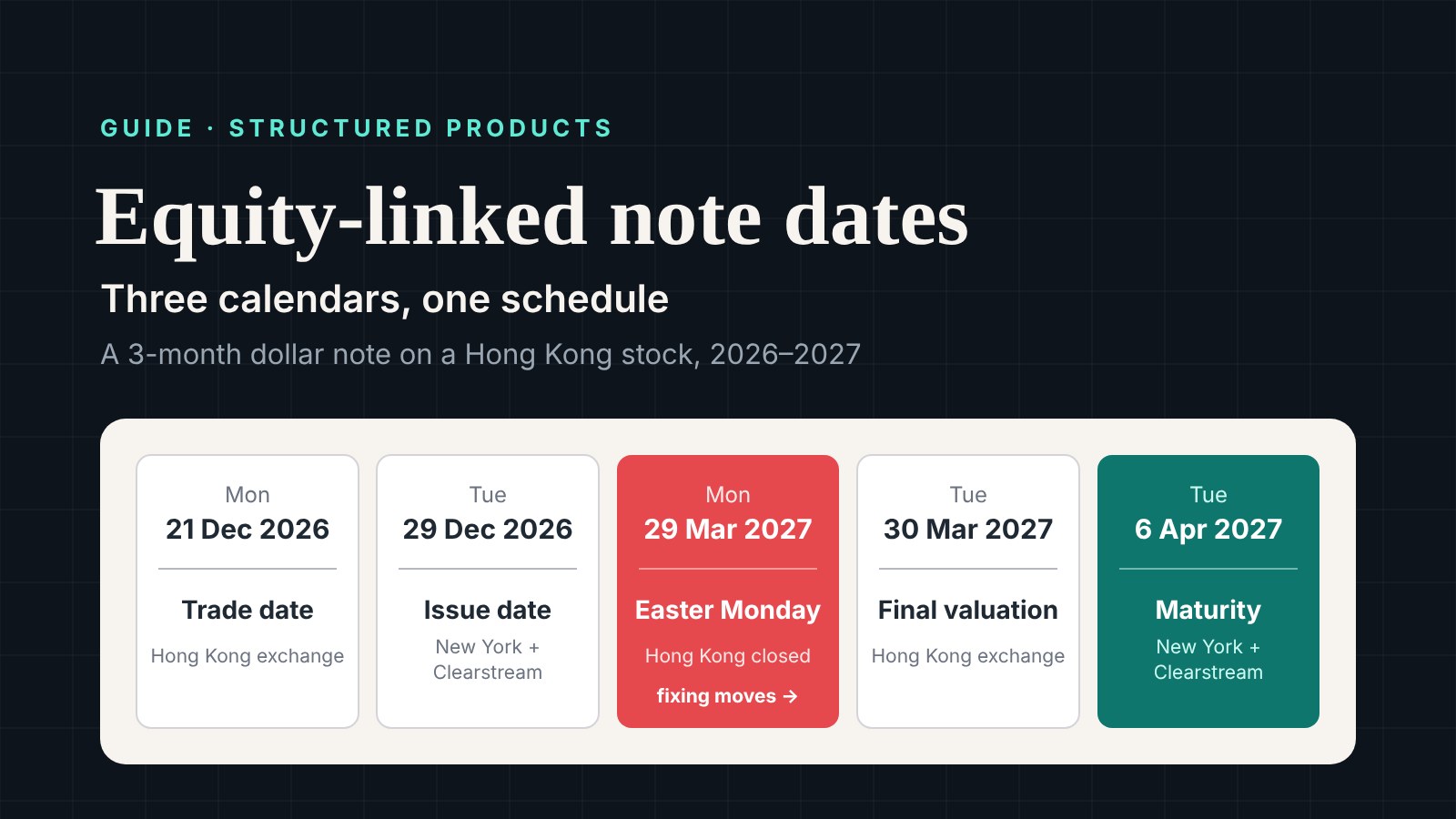
A three-month note in US dollars, linked to a stock listed in Hong Kong:
- Trade date: Monday 21 December 2026.
- Issue date: 5 payment business days after the trade date.
- Final valuation: 3 months after the issue date, moved to the next Hong Kong trading day.
- Maturity: 5 payment business days after the final valuation.
- Payment business days: open in New York and at Clearstream.
| Date | Result | Why |
|---|---|---|
| Trade date | Mon 21 Dec 2026 | Hong Kong is open. |
| Issue date | Tue 29 Dec 2026 | Five payment days: 22, 23, 24, 28 and 29 December. Christmas Day is skipped. |
| Scheduled final valuation | Mon 29 Mar 2027 | Three months after 29 December. |
| Final valuation | Tue 30 Mar 2027 | 29 March is Easter Monday. Hong Kong is closed. |
| Maturity | Tue 6 Apr 2027 | Five payment days: 31 March, then 1, 2, 5 and 6 April. |
- Fri 26 Mar: Good Friday
- Mon 29 Mar: Easter Monday
Red: closed. Amber: half day or early close. Grey: weekend. Full XHKG.TRADE calendar
Three things to notice.
New York is open on Easter Monday. A system that fixed the option on the payment calendar would pick 29 March. The Hong Kong market is shut that day. There is no price to fix.
Hong Kong is closed on 5 April for Ching Ming. That does not move the payment. The money moves in dollars, through New York and Clearstream. The stock exchange has no say in it.
Christmas Eve is a half day in Hong Kong. The market closes at noon. It is still a scheduled trading day. A fixing that day uses the price at the noon close.
When the market is disrupted#
A trading day can still go wrong. The exchange may halt trading or close early without notice. ISDA calls this a disrupted day.
Most term sheets then move the fixing to the next day that is not disrupted. They stop after eight scheduled trading days. On the last day, the calculation agent sets the price itself. Maturity moves with the fixing.
A holiday is not a disruption. It is known in advance, so the schedule is built around it from the start. That is why the exchange calendar must be right on the day the note is priced.
Get the dates by API#
Move the scheduled valuation date to the next Hong Kong trading day:
curl "https://api.tradingcalendars.com/v1/adjust-date?calendars=XHKG.TRADE&date=2027-03-29&convention=following" \
  -H "Authorization: Bearer YOUR_API_KEY"
The answer is 30 March 2027, with Easter Monday listed as the reason.
Then count 5 payment business days to maturity:
curl "https://api.tradingcalendars.com/v1/add-business-days?calendars=USNYC.BANK,CLEARSTREAM.PAY&date=2027-03-30&days=5" \
  -H "Authorization: Bearer YOUR_API_KEY"
The answer is 6 April 2027.
The whole schedule in Python, with our open-source client:
from tradingcalendars import TradingCalendars

tc = TradingCalendars(api_key="YOUR_API_KEY")
pay = ["USNYC.BANK", "CLEARSTREAM.PAY"]

issue = tc.add_business_days(pay, "2026-12-21", 5)               # 2026-12-29
valuation = tc.add_business_days("XHKG.TRADE", "2027-03-29", 0)  # 2027-03-30
maturity = tc.add_business_days(pay, valuation, 5)               # 2027-04-06
Adding 0 business days moves a closed date to the next open day.
Checklist#
- Fixings use the stock exchange calendar.
- Payments use the note currency and the clearing system calendars.
- Scheduled dates add months, not days.
- The day count sets coupon amounts, never dates.
- Maturity follows the final valuation date.
- Estimated holidays can still move. Holidays set by the moon, such as Chinese New Year, are estimated until the official list is out.
For swaps and other long-dated trades, see holiday calendars for derivatives.
Sources#
- HKEX: 2027 trading holidays circular
- Federal Reserve: Holidays observed
- Clearstream: Cash and securities holidays
- ISDA: 2002 Equity Derivatives Definitions
About the author: Julien Desaunay, Founder, TradingCalendars.com
Julien works in fintech on derivatives pricing and risk technology, where every cash flow depends on the right holiday calendar. He founded TradingCalendars.com to make those calendars reliable and easy to use.
Calendars in this guide
Get new guides by email
Plus next week's market holidays every Friday. Unsubscribe in one click.
More guides
- Which holiday calendar do you need? Bank, payment, FX, trading or settlement
A country has more than one holiday calendar. On Columbus Day the NYSE trades but US banks are closed. Here are the six kinds of calendar, where they differ, and which one to use.
- How to calculate business days: holidays, joint calendars and odd weekends
Skipping weekends is not enough. Here is how to add and count business days correctly, with holidays, two cities at once, Gulf weekends and China's working Sundays.
- Payout and value dates across currencies: why holidays delay payments
A payout due on Thursday can land on Tuesday. Here is how holidays in the sending currency, the FX conversion and the receiving currency set the real arrival date, and how to tell your customers.