Guide
Payout and value dates across currencies: why holidays delay payments
A payout due on Thursday can land on Tuesday. Here is how holidays in the sending currency, the FX conversion and the receiving currency set the real arrival date, and how to tell your customers.

Julien Desaunay
Last reviewed 9 November 2026 · 4 min read
You promise a seller, a freelancer or an employee that their money arrives on Friday. It arrives on Monday. Nothing failed. A holiday got in the way, in a country you were not even thinking about.
This guide explains how holidays delay payouts and cross-border payments. It shows how to work out the real arrival date, and how to tell your customers in advance.
The value date#
The value date is the day the money is available to the person you pay. For a payment to have a value date, the currency has to settle that day. That needs the currency's payment system to be open.
So the first rule is simple. A payment in a currency settles only on a business day for that currency. US dollars settle through Fedwire, euros through TARGET2, sterling through CHAPS.
Each currency has its own closed days. Here are six currencies at the end of 2026. A cross means the currency does not settle that day.
| Date | USD.CLEAR | EUR.CLEAR | GBP.CLEAR | JPY.CLEAR | PHP.CLEAR | MXN.CLEAR |
|---|---|---|---|---|---|---|
| Thu, 24 Dec 2026 | ✕ | |||||
| Fri, 25 Dec 2026 | ✕ | ✕ | ✕ | ✕ | ✕ | |
| Mon, 28 Dec 2026 | ✕ | |||||
| Wed, 30 Dec 2026 | ✕ | |||||
| Thu, 31 Dec 2026 | ✕ | ✕ | ||||
| Fri, 1 Jan 2027 | ✕ | ✕ | ✕ | ✕ | ✕ | ✕ |
Weekdays only. ✕ closed, ½ half day or early close, blank: open.
The dates are spread out. The Philippine peso closes on 24, 25, 30 and 31 December. The yen closes on 31 December. Sterling closes on Monday 28 December for Boxing Day. A single "Christmas break" rule would be wrong for most of them.
Three calendars for one payout#
A cross-border payout usually crosses three calendars:
- The sender's side. Your bank or payment provider must be open to send the money. If you fund payouts in sterling, a UK bank holiday stops you.
- The FX conversion, if there is one. Converting sterling to pesos settles only on a day open in both currencies.
- The receiving currency. The money lands only on a day the receiving currency settles.
The payout arrives on the first day that works for all three.
A worked example#
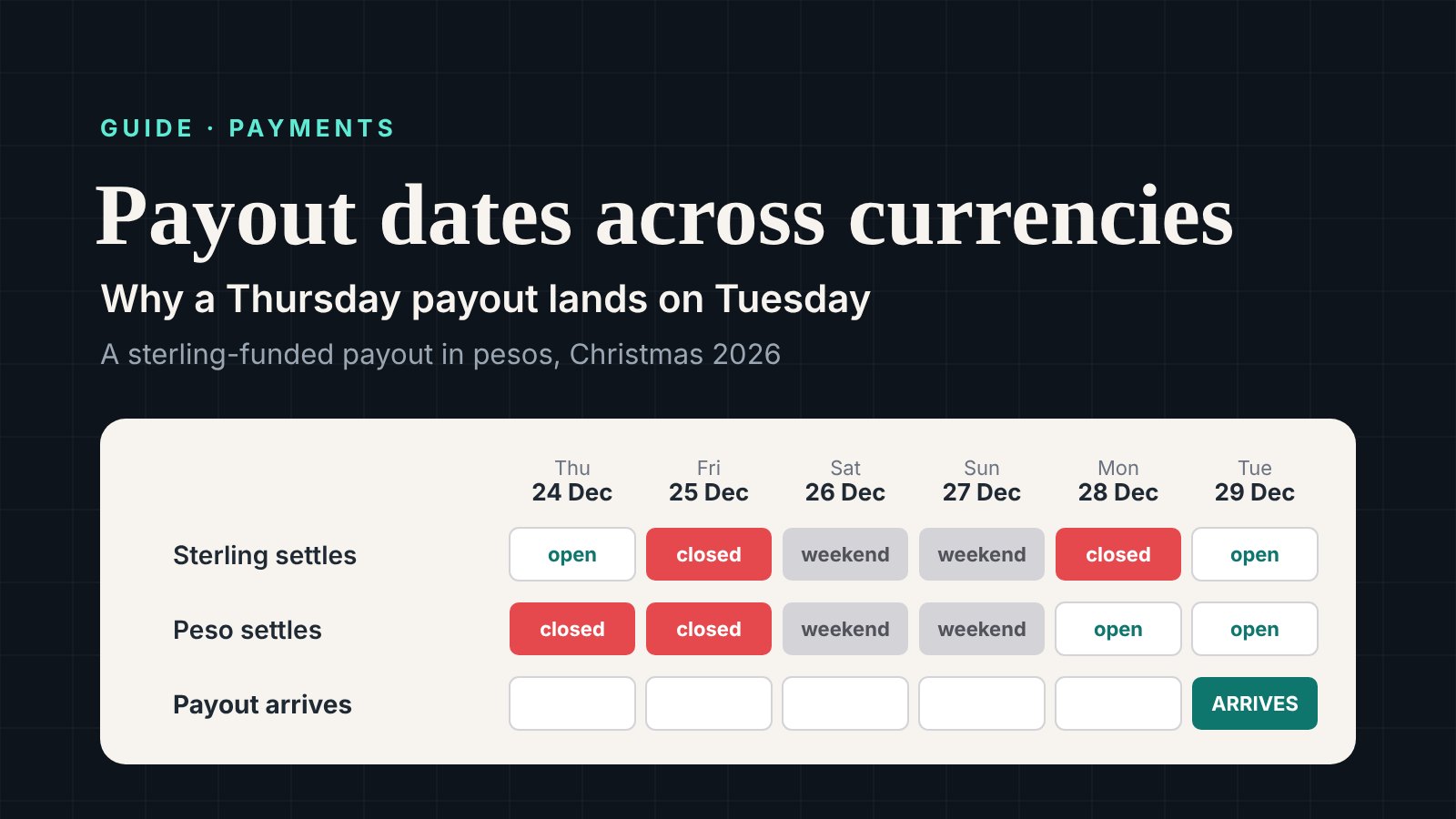
A UK platform pays freelancers in the Philippines. It funds the payouts in sterling. A payout is due on Thursday 24 December 2026.
- 24 and 25 December: the peso does not settle. Christmas Eve and Christmas Day are holidays in the Philippines.
- 26 and 27 December: weekend.
- Monday 28 December: the peso settles, but sterling does not. It is the Boxing Day holiday in the UK, so the conversion cannot settle.
- Tuesday 29 December: both are open. The payout arrives.
So "Thursday" becomes "Tuesday", five days later. With a peso payout funded in pesos, it would have been Monday.
Cut-off times#
Payment systems also have a daily cut-off time. A payment sent after the cut-off goes out on the next business day. On the day before a holiday, a late payment can lose several days. Some banks also close early on days such as Christmas Eve.
How to tell your customers#
A payout platform cannot move holidays. But it can stop them from being a surprise.
- Show the real date. When a payout is created, work out the arrival date with the right calendars, and show that date.
- Say why. A short note saves a support ticket. For example: "Your payout arrives on Tuesday 29 December, due to holidays in the Philippines and the UK."
- Warn ahead. Long breaks come every year, such as the Spring Festival in China or Eid in the Gulf. Before them, tell customers to send early.
- Pay early, not late. If a payout must arrive by a set day, move it to the business day before a holiday.
Watch out for estimated dates#
Some holidays are not fixed far ahead. Eid depends on the moon, and China sets its holiday plan each November. Until they are confirmed, the dates are estimates. Our guide to estimated dates explains how they get confirmed. For payouts, treat an estimated holiday as real, and plan around it.
A checklist#
- Use settlement calendars, not public holiday lists. A currency can settle on some public holidays, and close on days that are not.
- Join the calendars of the sending side, the FX conversion and the receiving currency.
- Check cut-off times and early closes before a holiday.
- Show customers the arrival date, with the reason when it moves.
- Refresh your data often. One-off holidays can appear with days of notice.
Try it#
Find the arrival date for the example above. Add 0 business days to 24 December 2026 for sterling and peso settlement. Zero days rolls a closed date forward to the next open one.
curl "https://api.tradingcalendars.com/v1/add-business-days?calendars=GBP.CLEAR,PHP.CLEAR&date=2026-12-24&days=0" \
  -H "Authorization: Bearer YOUR_API_KEY"
The answer is 29 December 2026, with each skipped day and its reason. To list every closed day of a currency, use the currency non-clearing days endpoint. More examples are in our payouts and payments use case.
Sources#
- Federal Reserve: Holidays observed by the Federal Reserve System
- European Central Bank: TARGET2 closing days
- UK government: Bank holidays
- Philippines: Proclamation No. 1006, holidays for 2026
About the author: Julien Desaunay, Founder, TradingCalendars.com
Julien works in fintech on derivatives pricing and risk technology, where every cash flow depends on the right holiday calendar. He founded TradingCalendars.com to make those calendars reliable and easy to use.
Calendars in this guide
Get new guides by email
Plus next week's market holidays every Friday. Unsubscribe in one click.
More guides
- How to build the date schedule of an equity-linked note
An equity-linked note uses three calendars: the stock exchange for fixings, the note currency for payments, and the clearing system. Here is how each date is set, with a worked example.
- Which holiday calendar do you need? Bank, payment, FX, trading or settlement
A country has more than one holiday calendar. On Columbus Day the NYSE trades but US banks are closed. Here are the six kinds of calendar, where they differ, and which one to use.
- How to calculate business days: holidays, joint calendars and odd weekends
Skipping weekends is not enough. Here is how to add and count business days correctly, with holidays, two cities at once, Gulf weekends and China's working Sundays.