Guide
How to calculate business days: holidays, joint calendars and odd weekends
Skipping weekends is not enough. Here is how to add and count business days correctly, with holidays, two cities at once, Gulf weekends and China's working Sundays.

Julien Desaunay
Last reviewed 9 November 2026 · 4 min read
"Pay within 3 business days." "Settles T+2." "Allow 5 working days." Business days are everywhere in finance. Counting them looks easy: skip Saturdays and Sundays. But that simple rule is wrong more often than you would think.
This guide shows how to add and count business days correctly. It covers holidays and joint calendars. It also covers odd weekends, and weekend days that become working days.
Weekdays are not business days#
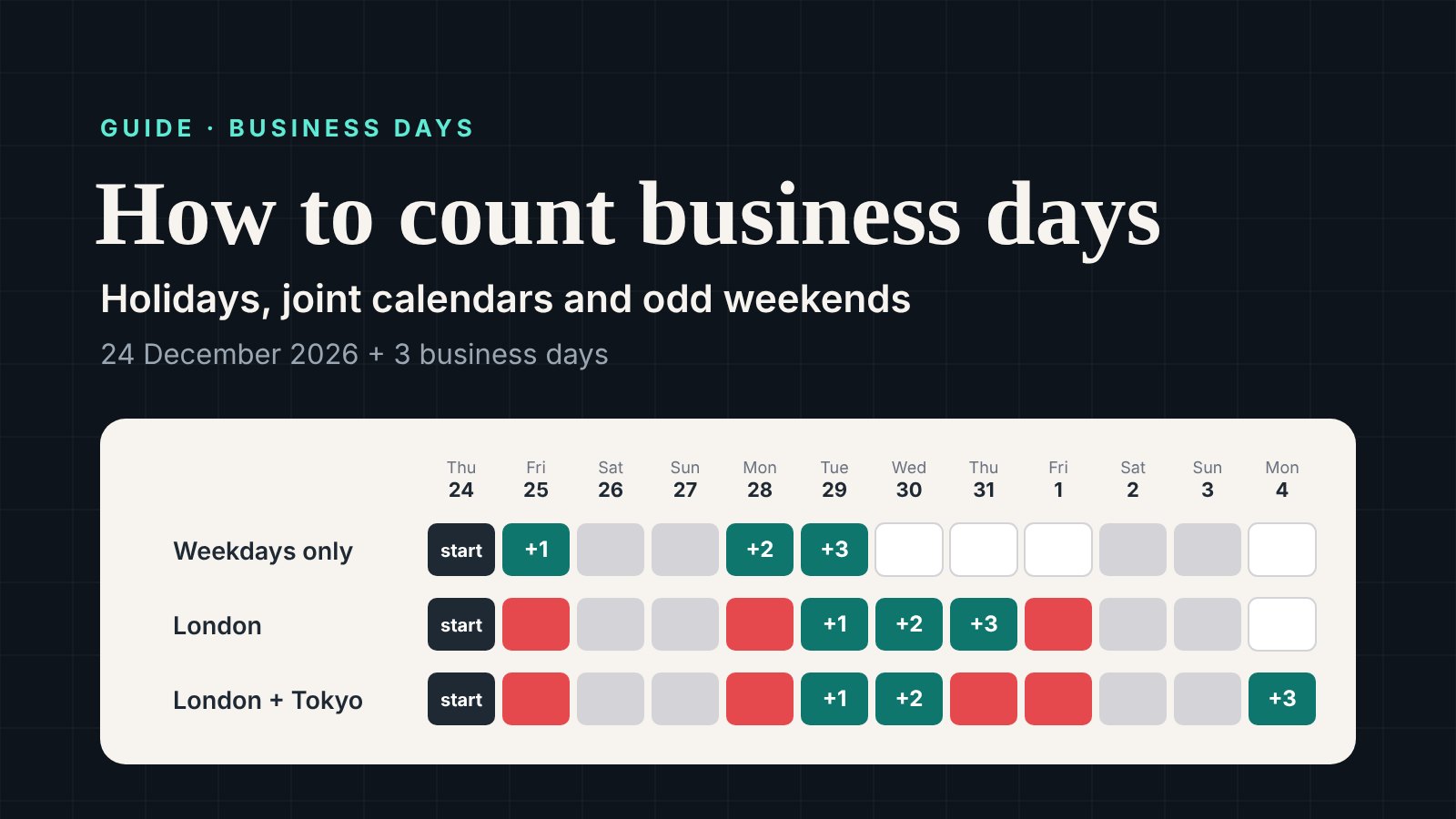
Take Thursday 24 December 2026 in London. What date is 3 business days later?
If you only skip weekends, you count Friday 25, Monday 28 and Tuesday 29. The answer looks like Tuesday 29 December.
But 25 December is Christmas Day. And 26 December, Boxing Day, falls on a Saturday, so the bank holiday moves to Monday 28. The real count is Tuesday 29, Wednesday 30 and Thursday 31. The right answer is Thursday 31 December, two days later.
- Fri 25 Dec: Christmas Day
- Mon 28 Dec: Boxing Day
Red: closed. Amber: half day or early close. Grey: weekend. Full GBLON.BANK calendar
Every business-day sum needs three things:
- A start date.
- The calendars that must be open, such as London banks.
- The weekend days of each calendar.
Two places, one answer#
Many dates must work in two places at once. A payment from London to Tokyo needs banks open in both cities. So a business day is a day that is open in every calendar.
Let's repeat the sum from 24 December 2026, but for London and Tokyo together:
- 25 and 28 December are closed in London.
- 29 and 30 December are open in both. That is day 1 and day 2.
- Tokyo banks close from 31 December to 3 January.
- 1 January is closed in both.
- Monday 4 January 2027 is open in both. That is day 3.
So the answer moves from 31 December to 4 January 2027. Adding a second city added four calendar days.
Not every weekend is Saturday and Sunday#
Some markets rest on other days. And some have changed their weekend in recent years.
| Market | Weekend | Since |
|---|---|---|
| Saudi Arabia | Friday and Saturday | June 2013 (Thursday and Friday before) |
| UAE | Saturday and Sunday | January 2022 (Friday and Saturday before) |
| Tel Aviv Stock Exchange | Saturday and Sunday | January 2026 (Friday and Saturday before) |
So a Friday is a normal working day in Dubai, but not in Riyadh. And a date in 2021 needs the old UAE weekend, not the new one.
When a weekend day is a working day#
China moves working days onto weekends to make long holidays. For the Spring Festival in 2027, the break runs from 5 to 13 February. To make up for it, Sunday 31 January and Sunday 14 February are working days.
On those days, banks and the interbank FX market are open. A rule that skips every Sunday will miss them.
Counting business days between two dates#
Counting has one more trap: do you count the first day, the last day, or both?
- Excel's
NETWORKDAYScounts both the start and the end date. - numpy's
busday_countcounts the start date, but not the end date.
Our API works like numpy. The start date counts and the end date does not. Take London from 1 December 2026 to 1 January 2027. December has 23 weekdays. Take away Christmas Day and the Boxing Day holiday on the 28th. That leaves 21 business days.
Pick one rule, write it down, and use it everywhere. Two systems with different rules will disagree by one day.
Moving a date that falls on a holiday#
Adding business days is not the same as moving one date to the next open day. For a payment date in a contract, the rules are set by a business day convention:
- Following: move to the next business day.
- Modified following: move to the next business day, unless that is in the next month. Then move back instead.
- Preceding: move to the previous business day.
These conventions come from the ISDA Definitions. Our guide on holiday calendars for derivatives explains them in more detail.
A checklist#
- Use the right calendars. Banks, payment systems and exchanges close on different days. See which holiday calendar you need.
- Join calendars when a date involves two places. The day must be open in all of them.
- Use each calendar's own weekend, including past changes.
- Include working weekends where they exist.
- Agree how you count. Say whether the start and the end date are included.
- Refresh the data. Holidays get added every year.
Try it#
Add 3 business days to 24 December 2026, for London and Tokyo banks together:
curl "https://api.tradingcalendars.com/v1/add-business-days?calendars=GBLON.BANK,JPTYO.BANK&date=2026-12-24&days=3" \
  -H "Authorization: Bearer YOUR_API_KEY"
The answer is 4 January 2027. It also lists each day that was skipped, and why.
Count the business days in December 2026 for London banks:
curl "https://api.tradingcalendars.com/v1/business-days-between?calendars=GBLON.BANK&start=2026-12-01&end=2027-01-01" \
  -H "Authorization: Bearer YOUR_API_KEY"
In Python, our open-source client does the same in one line each.
Sources#
- UK government: Bank holidays
- Saudi Central Bank: Holiday schedules
- State Council of China: 2027 holiday plan
- NumPy: busday_count
- Microsoft: NETWORKDAYS function
About the author: Julien Desaunay, Founder, TradingCalendars.com
Julien works in fintech on derivatives pricing and risk technology, where every cash flow depends on the right holiday calendar. He founded TradingCalendars.com to make those calendars reliable and easy to use.
Calendars in this guide
Get new guides by email
Plus next week's market holidays every Friday. Unsubscribe in one click.
More guides
- How to build the date schedule of an equity-linked note
An equity-linked note uses three calendars: the stock exchange for fixings, the note currency for payments, and the clearing system. Here is how each date is set, with a worked example.
- Which holiday calendar do you need? Bank, payment, FX, trading or settlement
A country has more than one holiday calendar. On Columbus Day the NYSE trades but US banks are closed. Here are the six kinds of calendar, where they differ, and which one to use.
- Payout and value dates across currencies: why holidays delay payments
A payout due on Thursday can land on Tuesday. Here is how holidays in the sending currency, the FX conversion and the receiving currency set the real arrival date, and how to tell your customers.