Guide
Why some holiday dates are estimates: Eid, Chinese New Year and Diwali
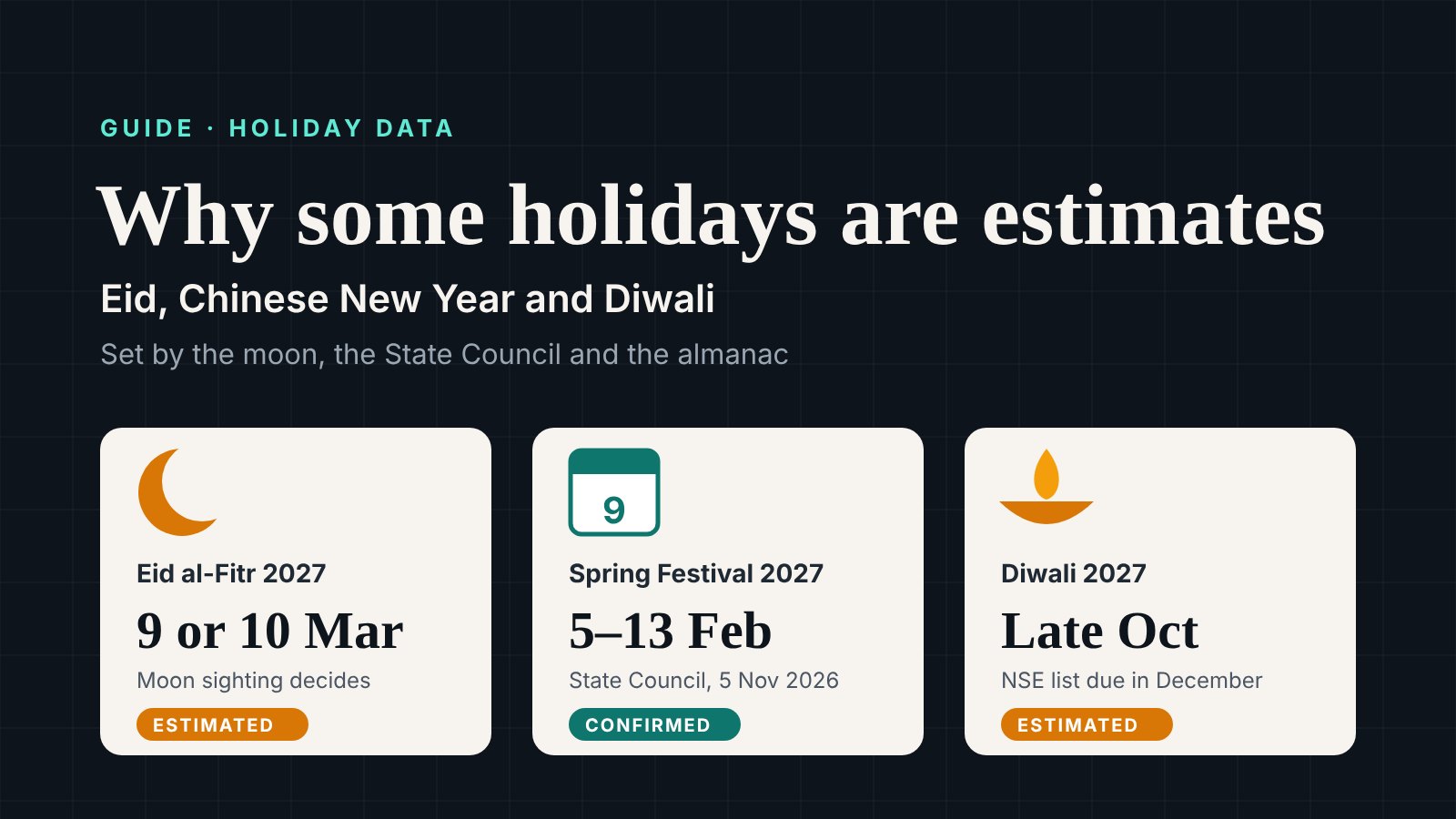
Eid depends on the moon. China sets its New Year break each November. India lists Diwali late in the year. Here is why these dates start as estimates, and how they get confirmed.

Julien Desaunay
Last reviewed 9 November 2026 · 5 min read
Most holidays have a fixed date or a simple rule. Christmas is on 25 December. Thanksgiving is the fourth Thursday of November. You can compute them for any year.
Some big holidays do not work like that. Eid depends on the moon. Chinese New Year has a known date, but the days off are set each year. Diwali comes from a lunar calendar that experts can read in different ways.
So for these holidays, a calendar holds a best guess until the official notice comes out. This guide explains why, when each one is confirmed, and how to handle the gap.
Eid: set by the moon#
The Islamic calendar is lunar. A month has 29 or 30 days. A new month starts when the new crescent moon is seen.
On the evening of the 29th day of Ramadan, people look for the moon. If it is seen, Eid al-Fitr is the next day. If not, Ramadan runs for 30 days, and Eid is a day later.
That means the final date is often known only the evening before. A calendar can only say "Eid is on one of these two days" until then.
Three more things make Eid tricky:
- It moves. The lunar year is about 11 days shorter than the solar year. Eid al-Fitr was around 20 March in 2026. It will be around 9 March in 2027 and around 26 February in 2028.
- Countries can differ. Some countries rely on their own moon sighting. Others use astronomical tables. The same Eid can start a day apart in two markets.
- The break length varies. Saudi banks may close for most of a week. Other markets close for two or three days.
You can see the gaps in our estimates for Eid al-Fitr 2027. Saudi Arabia, the UAE and Turkey start on 9 March. Malaysia and Pakistan start on 10 March.
| Date | SAR.FX | AED.FX | TRY.FX | MYR.FX | PKR.FX |
|---|---|---|---|---|---|
| Mon, 8 Mar 2027 | ✕ | ½ | |||
| Tue, 9 Mar 2027 | ✕ | ✕ | ✕ | ||
| Wed, 10 Mar 2027 | ✕ | ✕ | ✕ | ✕ | ✕ |
| Thu, 11 Mar 2027 | ✕ | ✕ | ✕ | ✕ | ✕ |
| Fri, 12 Mar 2027 | ✕ | ✕ |
Weekdays only. ✕ closed, ½ half day or early close, blank: open.
Chinese New Year: set by the State Council#
The date of Chinese New Year comes from the Chinese lunisolar calendar. It can be worked out years ahead. In 2027, the first day of the new year is Saturday 6 February.
But the days off are not set by the calendar alone. Each year, China's State Council publishes the holiday plan for the next year. It often joins the holiday to nearby weekends to make a long break. To pay for that, some weekend days become working days.
The plan for 2027 came out on 5 November 2026. The Spring Festival break runs from Friday 5 February to Saturday 13 February. That is nine days. Sunday 31 January and Sunday 14 February are working days.
Until the notice is out, only the first days around the new year are a safe guess. The full break, and the extra working days, are only known once the State Council publishes.
Diwali: set by almanacs and exchange lists#
Hindu festivals follow a lunisolar calendar. Diwali falls on a new moon night, in October or November.
Almanacs, called panchangs, do not always agree on the exact day. So India's holiday lists are set each year:
- The central government publishes the official holiday list for its offices.
- The Reserve Bank of India lists bank holidays for each state.
- The National Stock Exchange (NSE) publishes its trading holiday list for the next year, usually in December.
Diwali also brings a special case. On Diwali evening, the NSE and BSE hold a short "Muhurat" trading session. In 2026, Diwali Laxmi Pujan fell on Sunday 8 November. So the exchanges opened on a Sunday for about an hour. The time of the session is announced only a few weeks before.
How the date gets confirmed#
Each holiday has its own moment of truth:
| Holiday | Can be computed | Confirmed by | When |
|---|---|---|---|
| Eid al-Fitr, Eid al-Adha | Roughly, within a day or two | Moon sighting, then government or central bank notice | Often days before, sometimes the evening before |
| Chinese New Year | Yes, the date itself | State Council holiday plan | Usually in November of the year before |
| Diwali | Roughly, within a day | Government lists, RBI, NSE holiday list | Usually late in the year before |
Until then, the best a calendar can do is give a careful estimate and say so clearly.
How we mark estimates#
Every holiday in our data has an is_estimated field. It is true while the date is still a forecast, and false once an official source confirms it.
{
  "date": "2027-03-09",
  "event": "Eid Al Fitr",
  "is_estimated": true
}
The flag also shows up in the date tools. The adjust-date and schedule endpoints list the closed days they skipped. A skipped day that is still an estimate carries "is_estimated": true. So you can tell when a payment date depends on a guess.
On our calendar pages, these dates carry an "Estimated" label.
When a date is confirmed, we update it and clear the flag. For example, on 6 November 2026 we added the Saudi Eid eves from SAMA's table to the SAR calendar. These changes are listed in our calendar updates.
What to do in practice#
- Find the estimates. Check
is_estimatedon any date your payments, trades or reports rely on. - Leave room. Around Eid, avoid planning a payment on the day before or after an estimated holiday when you can.
- Refresh your data. Pull calendars again before each key date, not once a year.
- Watch the notices. Expect China's plan in November, India's lists late in the year, and Eid notices close to the day.
- Get alerts. Subscribe to Calendar updates in our newsletter. You get an email when a date is confirmed or changed.
Try it#
This call lists the 2027 FX holidays for the Saudi riyal, with the is_estimated flag on each date.
curl "https://api.tradingcalendars.com/v1/fx-market-holidays?currency=SAR&start=2027-01-01&end=2027-12-31" \
  -H "Authorization: Bearer YOUR_API_KEY"
- Sun 7 Mar: Eid Al Fitr (second eve)
- Mon 8 Mar: Eid Al Fitr (eve)
- Tue 9 Mar: Eid Al Fitr
- Wed 10 Mar: Eid Al Fitr (Day 2)
- Thu 11 Mar: Eid Al Fitr (Day 3) (estimated)
- Fri 12 Mar: Eid Al Fitr (Day 4) (estimated)
Red: closed. Amber: half day or early close. Grey: weekend. Full SAR.FX calendar
Sources#
- Saudi Central Bank: Holiday schedules
- Argaam: SAMA sets holidays and work hours through 2029
- Xinhua: State Council notice on the 2027 holiday plan
- National Stock Exchange of India: Trading holidays
About the author: Julien Desaunay, Founder, TradingCalendars.com
Julien works in fintech on derivatives pricing and risk technology, where every cash flow depends on the right holiday calendar. He founded TradingCalendars.com to make those calendars reliable and easy to use.
Calendars in this guide
Get new guides by email
Plus next week's market holidays every Friday. Unsubscribe in one click.
More guides
- How to build the date schedule of an equity-linked note
An equity-linked note uses three calendars: the stock exchange for fixings, the note currency for payments, and the clearing system. Here is how each date is set, with a worked example.
- Which holiday calendar do you need? Bank, payment, FX, trading or settlement
A country has more than one holiday calendar. On Columbus Day the NYSE trades but US banks are closed. Here are the six kinds of calendar, where they differ, and which one to use.
- How to calculate business days: holidays, joint calendars and odd weekends
Skipping weekends is not enough. Here is how to add and count business days correctly, with holidays, two cities at once, Gulf weekends and China's working Sundays.