Guide
T+1 in Europe: what changes on 11 October 2027
The EU, the UK and Switzerland move from T+2 to T+1 on Monday 11 October 2027. Here is the switch week, why holidays now matter more, and what settlement systems need to change.

Julien Desaunay
Last reviewed 9 November 2026 · 4 min read
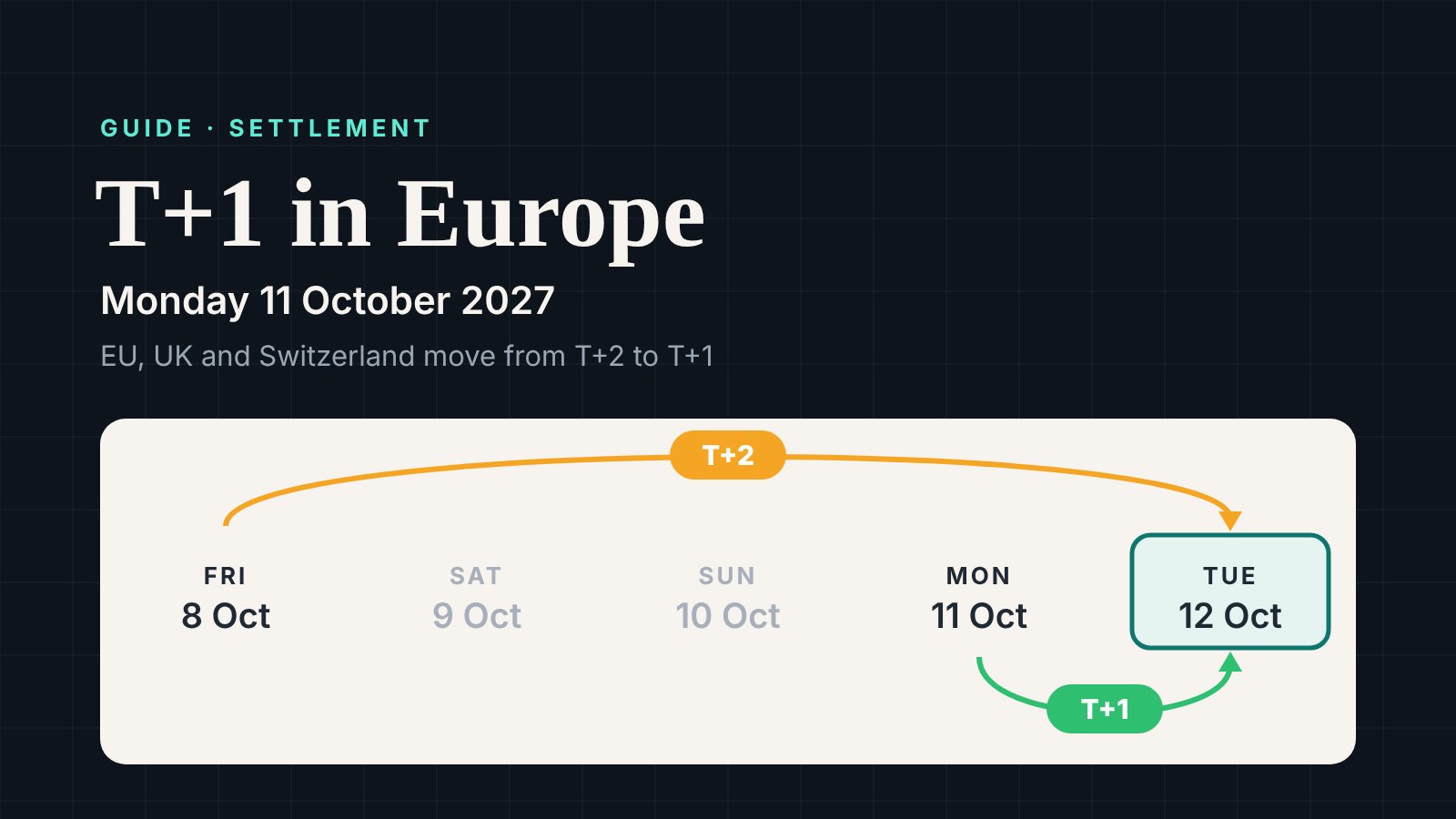
The EU, the UK and Switzerland switch to T+1 on Monday 11 October 2027. Trades will settle one day after the trade, not two. A share bought on a Monday will settle on Tuesday, not Wednesday.
One day sounds small. But it removes the buffer that hid many calendar mistakes. This guide shows what changes, what happens on the switch day, and where holidays will now bite.
What changes#
T+1 means a trade settles one settlement day after the trade date. Settlement days are counted on the settlement calendar of the market, not on the calendar of the country.
| Market | Until Friday 8 October 2027 | From Monday 11 October 2027 |
|---|---|---|
| European Union | T+2 | T+1 |
| United Kingdom | T+2 | T+1 |
| Switzerland and Liechtenstein | T+2 | T+1 |
| United States, Canada, Mexico | T+1 since May 2024 | T+1 |
The cycle that applies depends on the trade date. A trade done before 11 October settles T+2, even if it settles after the switch.
Switch week: two trade days, one settlement day#
The last T+2 trades and the first T+1 trades settle on the same day.
| Trade date | Cycle | Settles |
|---|---|---|
| Friday 8 October 2027 | T+2 | Tuesday 12 October 2027 |
| Monday 11 October 2027 | T+1 | Tuesday 12 October 2027 |
So Tuesday 12 October 2027 carries two days of settlements. In our data, no European settlement calendar closes on 11 or 12 October 2027. So nothing else shifts that week.
With one day, holidays matter more#
Under T+2, a holiday on the day after the trade often went unnoticed. There was still a second day. Under T+1, the next settlement day is the settlement date. If it is a holiday in one market but not in another, the same trade settles on different days.
Christmas 2027 shows it well. Christmas Day and Boxing Day fall on a weekend. The UK moves its bank holidays to Monday 27 and Tuesday 28 December. The euro area does not.
| Trade date | London | Paris | New York |
|---|---|---|---|
| Friday 24 December 2027 | Wednesday 29 December | Monday 27 December | No trading |
| Friday 31 December 2027 | Tuesday 4 January 2028 | Monday 3 January 2028 | Monday 3 January 2028 |
London also closes on Monday 3 January 2028, because New Year's Day falls on a Saturday. Xetra and SIX do not trade on 24 or 31 December 2027. London and Paris close early on both days.
| Date | XLON.SETTLE | XETR.SETTLE | XPAR.SETTLE | XSWX.SETTLE | XNYS.SETTLE |
|---|---|---|---|---|---|
| Fri, 24 Dec 2027 | ✕ | ||||
| Mon, 27 Dec 2027 | ✕ | ||||
| Tue, 28 Dec 2027 | ✕ |
Weekdays only. ✕ closed, ½ half day or early close, blank: open.
What your systems need to do#
- Pick the cycle from the trade date. T+2 for trades up to Friday 8 October 2027, T+1 from Monday 11 October 2027.
- Count on the right calendar. Use each market's settlement calendar, such as LSE settlement or Xetra settlement. A list of national holidays is not enough.
- Check cross-border trades on both sides. A London trade and a Paris trade on the same day can settle on different days. Christmas 2027 shows it.
- Fund the trade earlier. Spot FX for EUR, GBP and CHF against the dollar settles T+2. Buying European shares with dollars on T+1 needs the currency a day sooner.
- Plan for the switch week. Expect two days of settlements on Tuesday 12 October 2027.
- Review fund dealing. In the UK, the FCA backs T+2 settlement for fund units. This applies to funds that invest mainly in T+1 markets.
Check any settlement date#
The API counts business days on any calendar. You choose the cycle; it applies the holidays.
from datetime import date
from tradingcalendars import TradingCalendars

tc = TradingCalendars()  # free API key

def settlement_date(calendar: str, trade_date: date) -> date:
    days = 1 if trade_date >= date(2027, 10, 11) else 2
    return tc.add_business_days([calendar], trade_date, days)

settlement_date("XLON.SETTLE", date(2027, 12, 24))   # date(2027, 12, 29)
settlement_date("XPAR.SETTLE", date(2027, 12, 24))   # date(2027, 12, 27)
settlement_date("XETR.SETTLE", date(2027, 10, 8))    # date(2027, 10, 12), still T+2
curl "https://api.tradingcalendars.com/v1/add-business-days?calendars=XLON.SETTLE&date=2027-12-24&days=1" \
  -H "Authorization: Bearer YOUR_API_KEY"
Settlement calendars for 61 exchanges are on the coverage page. More examples for brokers and custodians are in securities settlement.
Sources#
- European Union: Regulation (EU) 2025/2075, adopted 8 October 2025, applies from 11 October 2027
- United Kingdom: FCA, About T+1 settlement and the government's policy note on T+1. The regulations were published in draft in November 2025.
- Switzerland and Liechtenstein: Swiss Securities Post-Trade Council, T+1 recommendations
About the author: Julien Desaunay, Founder, TradingCalendars.com
Julien works in fintech on derivatives pricing and risk technology, where every cash flow depends on the right holiday calendar. He founded TradingCalendars.com to make those calendars reliable and easy to use.
Calendars in this guide
Get new guides by email
Plus next week's market holidays every Friday. Unsubscribe in one click.
More guides
- How to build the date schedule of an equity-linked note
An equity-linked note uses three calendars: the stock exchange for fixings, the note currency for payments, and the clearing system. Here is how each date is set, with a worked example.
- Which holiday calendar do you need? Bank, payment, FX, trading or settlement
A country has more than one holiday calendar. On Columbus Day the NYSE trades but US banks are closed. Here are the six kinds of calendar, where they differ, and which one to use.
- How to calculate business days: holidays, joint calendars and odd weekends
Skipping weekends is not enough. Here is how to add and count business days correctly, with holidays, two cities at once, Gulf weekends and China's working Sundays.